Yellow Foxtail-Grass Family
Foxtail millet, pigeon grass, summer grass, golden foxtail, wild millet, pussy-grass, bottle grass, yellow bristlegrass
Setaria glauca
Characteristics. This Eurasian native is now a common weed pest throughout the world. This summer annual reproduces from seeds germinating in early to late spring when temperatures reach between 68 and 95°F. Even though stem nodes that come in contact with the soil will not root, tillage of the roots will cause new growth from the base of the plant. Yellow foxtail occurs in moist, fertile soil during the mid to late growing season and is often found in new seedlings, open turf, or bare spots.
Identifying Characteristics. Yellow foxtail forms a coarse, upright or prostrate, bunch-type grass. It usually branches at the base and may root at lower nodes. Growing up to 4 feet tall, yellow foxtail emerges from a shallow, fibrous root system and normally has flattened stems that are reddish near the base. Leaves of yellow foxtail are flat, smooth, and with margins that are somewhat rough. They grow 2 to 12 inches long and up to 1/2 inch wide.
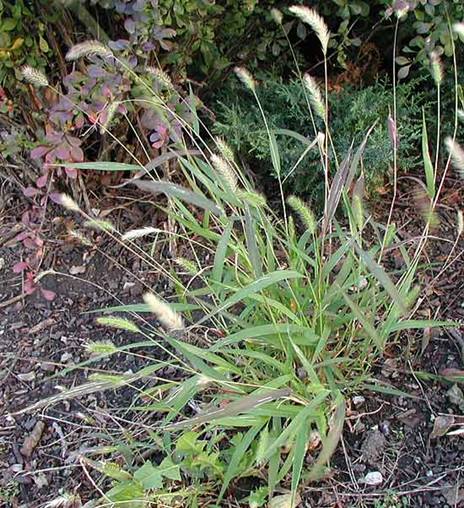

. Image courtesy of Midwestern Turfgrass Identification and Control Website.
Twisted or spiraled pubescent, 1/8 inch long, usually appear near the leaf base on the upper surface. The sheath is smooth and often reddish at the base, with a distinct midvein. Key characteristics: long, shaggy hair at base.
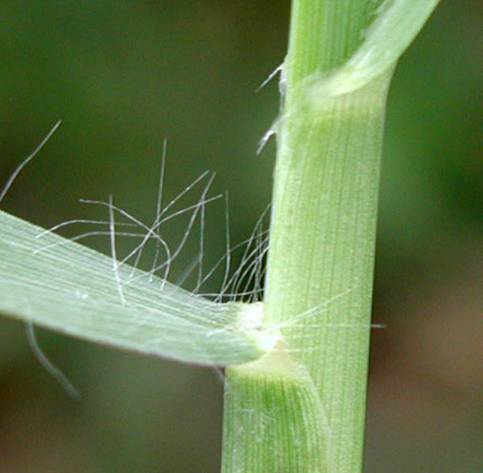
Image courtesy of Midwestern Turfgrass Identification and Control Website. .
The foxtail's primary weapon is its seed heads or awns. They transport the seed into fur, wool, socks, hair, tires, noses, toes, or any other vehicle the foxtail chooses. The barbed fibers in the seed head act like tiny fish hooks, driving the seed head further into the soil, skin, or hair. It is quite common for veterinarians to remove foxtails from the ears, noses, toes, and body tissues of animals (mostly dogs and cats). It can be an expensive procedure - and is almost always very unpleasant for the animal involved.
The best defense against this weedy menace is prevention. Cut or mow the weeds (or hire goats ... we're not kidding). Early in the spring, when the wild barley appears as innocent and tasty grass for horses and goats, the plant is harmless. Allowed to progress to seed stage, it will sprout green awns that are still rather harmless. However, if the weed is allowed to dry out to its dreaded golden state, the awn becomes a tiny missile launcher; brush by it with new socks on, and you'll have foxtails in the terry cloth until the socks are worn and done. The firing action is what also lobs the seed heads into the ears of dogs and cats - to nestle there against an eardrum until the veterinarian's probe and forceps remove it.
Mind you, the offensive arsenal of weed poison (not popular if one has animals in residence) and weed trimmers is only partially effective. Cut the plants down, more grow in their place, with more awns than before. Sometimes the foxtails will fly up into the trimmer operator's ears and nose. It goes without saying that sturdy pants and smooth boots are mandatory. Those seeds fly off of a trimmer's head and stick to anything in firing range.
The coup de gras for high expense regarding this nasty weed is its final vengeance: weed trimmers tend to hit and launch rocks. A broken window here and there in the house seems to have the foxtails laughing. In one reported household, foxtails have run up a $1,000.00 bill due to vet bills for foxtails in dogs' ears, and (so far - spring isn't over yet) one broken window. Yes, indeed. The foxtails are laughing
Characteristic Important to Control. Yellow foxtail thrives in nutrient rich soil, thus enhancing its importance as a pest in crops and landscaping. To control yellow foxtail without chemicals, mechanically remove or hand pull. Maintain turf density and health through proper culture; avoid close mowing and summer fertilization. Apply preemergence herbicides one to two weeks prior to germination in the late spring or summer; use post emergence herbicides when weeds are small.