Radish-Mustard Family
Raphanus sativus
Characteristics. This annual is native to Europe and now is spread throughout the western United States. It is especially prevalent and troublesome in cereal crops although it is common in many cultivate crops and waste lands.
Identifying Characteristics. Radish grows erect forming large (2 to 5 feet tall) branching bush-like stands.
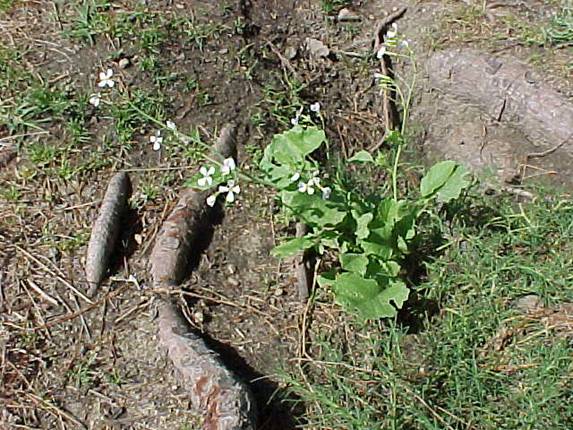
After emergence, wild radish forms a rosette of leaves throughout the winter and early spring. Seedling wild radish possess heart-shaped cotyledons and the first true leaves will be slightly serrated and indented about two to three times as long as wide. After emergence, wild radish forms a rosette of leaves throughout the winter and early spring. Seedling wild radish possess heart-shaped cotyledons and the first true leaves will be slightly serrated and indented about two to three times as long as wide. As the leaves mature, the serrations will be more jagged and more deeply indented. In addition, the leaves are covered with stiff hairs, giving a bristly feel to the touch.
.
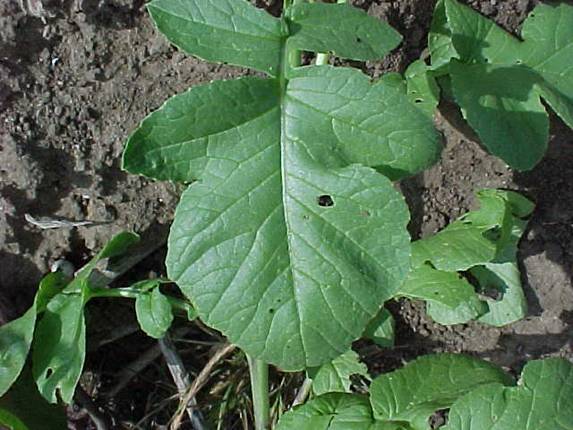
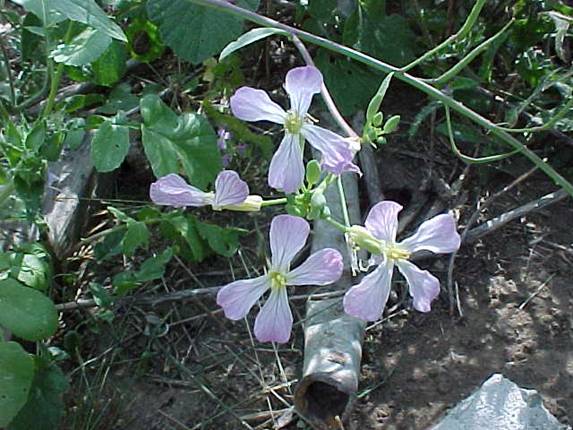
The wild radish plant remains in rosette form through most of the winter, reaching approximately 10 to 14 inches across at the base. In the late winter to early spring, as the temperature and day length increase, the plant bolts. Bolting is a process in which the internodes (regions of the stem between leaves) begin to lengthen and a flower stalk forms at the top. In wild radish, multiple flower heads form on several branches arising from a single flower stalk. The purple to pink flowers are approximately 3/4th inch wide with 4 petals with pink to purple veins.
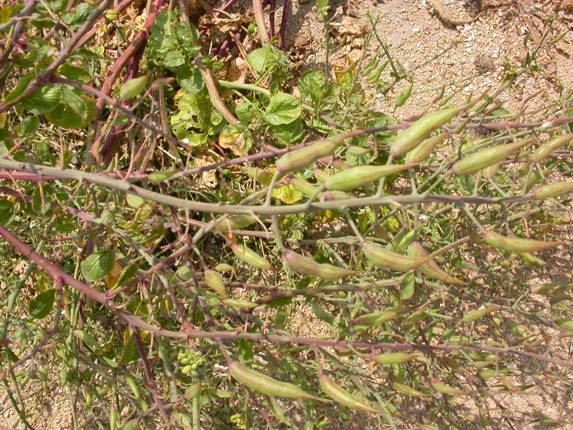
Seed pods are cylindrical, pointed at the tip and approximately 3 inches long.
Wild radish is one of the most common and problematic pasture weed. It can also be a serious pest in other crops including peanut, corn and winter vegetables. Wild radish (Raphanus raphanistrum) is a member of the Brassicaceae plant family with cabbage, turnip, and mustard. Most of these species are cool-season plants and have been introduced from eastern Europe and Asia. Wild radish has traditionally been classified as a winter annual. Generally, these species germinate during the fall months when soil temperatures drop below 65° F. Studies indicate a chilling requirement is necessary to break dormancy. In addition, wild radish has a thick fruit pod from which the seed does not shatter free easily. Therefore, the pod must decay before the seed can be released to germinate.
Prevention. The first step in controlling wild radish is prevention. Prevention can be addressed by two strategies. The first is reduction of the seed population in the soil, preventing the weed from infesting an area. This is accomplished by preventing the wild radish from going to seed (i.e., good early season control) and not allowing re-introduction from other sources. For example, sowing winter pastures with certified seed will avoid the possibility of spreading accidentally spreading weed seeds.
The second strategy is to maintain a dense pasture. Wild radish will grow most vigorously where there is a break in the sward. Therefore, proper grazing and soil fertility will likely minimized the impact of this particular weed.
Mechanical Control. Mechanical control of wild radish is a consideration, but rarely is it effective. Mowing will generally not harm the basal leaves and allow regrowth to occur within a short period of time. Additionally, a single wild radish plant will often produce many flushes of flowers and set several seed crops. Regular mowing cycles will reduce seed production, but will not eliminate seed production entirely. Frequent mowing will also reduce the productivity and forage yield of the pasture. Therefore, mowing to control wild radish is often more expensive and less effective than other options.
Chemical Control. One of the most common and cost effective methods of controlling wild radish is through the use of herbicides. Some of the most effective and inexpensive herbicides for wild radish control are growth regulators such as 2,4-D and dicamba. These herbicides provide excellent control of wild radish when properly applied. The growth regulating herbicides are generally considered safe on grasses. However, grass crops can be injured if these herbicides are applied incorrectly, or at the wrong developmental stage of the crop. Applications of phenoxy-type herbicides should be made to grain crops after two to three tillers have formed; plants are often 4 to 6 inches tall at this time. Applications of these materials before this stage of growth cause a "rat-tail" effect, whereby the leaf does not form and unfurl properly. In addition, the plant may appear stunted and delayed in maturity. Conversely, applications made after the jointing may result in malformed seedheads. Tolerance of cool season forages to herbicides will vary according to species. Generally, wheat is the most tolerant and oats are least tolerant to 2,4-D applications.
The timing of an herbicide application is critical for effective wild radish control. Research has shown that >90% wild radish control can be consistently achieved when 2,4-D is applied to plants less than 6 inches in height. By delaying the application until the plant reaches 12 inches, control drops to approximately 70%. However, if wild radish begins to flower before 2,4-D is applied, less than 50% control should be expected. Therefore, herbicides should be applied early to achieve the greatest wild radish control while avoiding herbicide injury to winter forage.
Applications with Nitrogen. It is a common practice for many growers to tank mix phenoxy materials with liquid nitrogen to reduce application costs. This practice is acceptable, but certain factors need consideration. The first is the size and density of the wild radish. Nitrogen should be applied near full tiller to maximize nitrogen needed for grain development. If the wild radish density and size is large, waiting this late may result in yield loss, and quite possibly a reduction in control. Applying nitrogen too early to gain a weed control advantage may result in nitrogen deficiency in late season during grain fill. The best rule of thumb is to apply each at its proper time and if these times coincide, a tank mix may be employed. If not, the factors above need to be weighed before such a practice is performed.
If planning to use 2,4-D in combination with nitrogen, herbicide formulation is important to note. The ester formulation of 2,4-D will readily mix with nitrogen solutions while the amine formulation must be mixed with water before adding to the nitrogen solution. Failure to preslurry with water can result in an uneven distribution of herbicide in the spray tank. It should also be noted that spraying the ester formulation of 2,4-D with a nitrogen carrier will often result in greater leaf burning as compared with amine formulation.
Wild radish is a common weed problem in winter forages. Managing wild radish depends on several factors. The most important factors are often weed size and crop stage at time of application. Regularly scouting fields will allow you to know the level of weed pressure in each field. Knowing this information will often make the herbicide application decisions much easier. All herbicides applied in grazing areas carry specific grazing restrictions. Please consult the herbicide label, or your local extension office, for more information on specific grazing restrictions.