Wild Oat-Grass Family
Avena fatua
Characteristics. This European import is quite common throughout the western United States. This erect growing annual is a serious pest of spring-seeded cereals but also occurs commonly in other cultivated crops, waste areas, landscaping and pastures. Once established in an area elimination may be difficult as the seeds may remain active in the soil for up to 10 years. Seed production occurs in the early spring through midsummer.
Identifying Characteristics. The rather thin, stiff, hollow stems of wild oats grow erectly to a height of 1 to 4 feet.

The inflorescence is rather characteristic and is best described as open, meaning the spiklets are sparingly and individually attached along the 4 to 18 inch flower stalk. More characteristically the small stem that attaches the spiklets to the stem is bent at an approximate right angle.
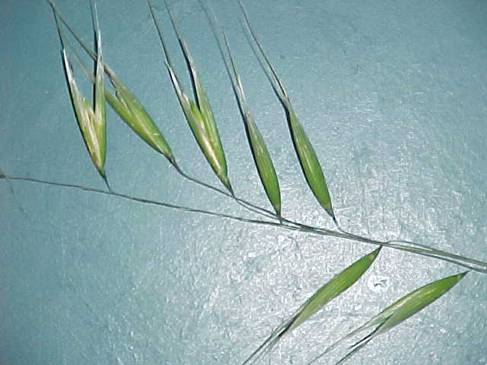
Wild-oat occurs on most types of soil but
is particularly troublesome in cereals on heavy land. It grows over a wide
climate range but prefers cool, temperate conditions.
Seed from different habitats and even from within the same habitat may have
different genotypes. Populations have developed with resistance to some widely
used graminicides. Phytotoxic chemicals that leach from wild-oat straw can
inhibit the germination and growth of other plants.
Wild-oat is a host of cereal cyst eelworm (Heteroderma avenae) and
cereal stem eelworm (Ditylenchus dipsaci). It can also be infected
with barley yellow dwarf virus and is attacked by several insects and fungi
that afflict cereals too. The frit fly (Oscinella frit) damages both
wild-oats and cultivated oats.
Biology: Wild-oat flowers from June to October. The first
panicles become visible above the cereal crop in early June but flowering and
panicle production can continue up until crop harvest. The flowers are normally
self-pollinated but some out-crossing can occur. Seeds become viable around 10
days after fertilization. In the absence of competition a single well-tillered
plant can produce up to 2,000 seeds. However, in a cereal crop the average seed
production is 60 seeds per plant. In a less competitive crop, a plant may
produce 200 seeds. Wild-oat seeds are shed as they ripen and this occurs over
an extended period. The later a crop is harvested, the more seed is shed onto
the ground leaving less to contaminate the cereal grain and straw. The seeds
possess a long, hygroscopic awn that twists and straightens with changes in
humidity pushing seeds into crevices in the soil.
Fresh seeds are dormant or rapidly become dormant but the level of dormancy
varies between populations. Temperature and moisture levels during seed
development can also affect the level of dormancy. Seed from the smaller
secondary floret is usually more dormant than the primary seed. In the autumn
the level of dormancy declines and is induced again in late-spring. Light may
inhibit seed germination. Damage to the seedcoat can relieve dormancy at
anytime by allowing oxygen to reach the seed. Applications of nitrogen-containing
fertilizers may break the dormancy of seeds exposed to high light levels.
Wild-oat has two main periods for germination but odd seedlings may appear at
anytime. There is a small autumn flush from September until early-November but
the main flush is from January to early-May. Germination is spread over several
weeks and is initiated when the soil temperature rises to 6°C and there is
sufficient moisture present. Wild-oat germinates at higher temperatures than
the winter wild-oat (A. sterilis L. ssp. ludoviciana)
Most seedlings originate from seeds in the top 80-100 mm of soil but some
emerge from a depth of 150-240 mm. Elongation of the first internode, or
mesocotyl, allows wild-oat seedlings to emerge from relatively deep soil
layers. Seedlings from deeper in the soil take longer to emerge and are weaker
initially. Early growth is slow but then accelerates. Seedlings are frost
sensitive until they reach the 3-leaf stage.
Persistence and Spread:
When seeds are left on the soil surface viability declines within a few
months due to germination, predation and fungal attack. Freshly shed seed
incorporated into the soil can remain dormant but viable for up to six years.
Land that has been down to pasture for 5-10 years has been found to be infested
with wild-oat when ploughed up. If the soil is cultivated regularly the
majority of seeds will only survive for 2-3 years. The shallower seeds will
germinate and emerge, deeper ones have dormancy enforced on them and cannot
germinate while those at intermediate depths may germinate but fail to emerge.
Under granary conditions, seed exhibited 50% germination after 1 year and 8%
after 4 years.
In cereals, up to 66% of wild-oat seeds are shed before harvest and 20% are
lost during the harvesting process. Around 7.5% remain in the harvested grain
and the rest are lost in the chaff and straw. Wild-oat was probably introduced
originally as a contaminant in cereal seed and the drilling of contaminated
grain allows that spread to continue. Farmer saved seed carries a higher risk
of contamination than commercial seed. Cereal straw can also carry quantities
of wild-oat seed, as can farmyard manure containing contaminated straw used for
bedding. The seed can be spread on or by farm machinery especially combine
harvesters and baling machines.
Mapping of wild oat infestations has shown that patches remain relatively
stable from year to year but expand by 1-3 m in the direction of harvesting and
cultivation. Without control a wild-oat population can increase annually by a
factor of 3 but there is too much variation to reliably predict the size of the
future population based on the extent of the current one.
Rumen digestion generally kills wild-oat seeds after 8-24 hours but diet can
affect this and some viable seeds may survive. Seeds that do pass through
unharmed may remain viable in manure for several weeks depending on the
temperature of the heap. Around 1% of seeds may still be viable after 2 weeks
windrow composting but after 4 weeks all are killed. The seed does not
generally survive in silage especially after its passage through the digestive
system of cattle.
Management: Conditions
that favor cereals benefit wild-oats too. They compete for the same resources
but the wild-oat is better able to compete in the root zone. The most
competitive wild-oat plants are those that emerge before or within 3 weeks of
the crop. These are also the ones that produce the majority of seeds. Preparing
the seedbed and drilling a cereal within days of harvesting the previous one
increases the wild oat problem. The use of combine harvesters has also
exacerbated the situation.
It is important to sow clean crop seed. Wild-oat control is improved by shallow
cultivations in autumn to induce a proportion
of seed to germinate and deeper working in spring to kill the emerged
seedlings. Preparing the seedbed around 3 weeks in advance of drilling will
allow the earliest wild-oat seedlings to be killed by cultivation. Harrowing
may remove later emerging seedlings as will hoeing in root crops. Seedlings are
susceptible to cultivation but tillered plants that are broken up may re-root.
Seedlings of wild-oat are smaller than those of cereals initially but soon
catch up and exceed the crop. The cereal needs to be able to build on its early
advantage with more rapid growth and establishment. In winter wheat increasing
crop density limits seed production by wild-oat. Narrower row spacing can also
help.
Hand
roguing of cereals is possible with weed populations of 400-500
wild-oat plants per ha but the weeds must exceed the height of the crop to make
this easier. The plants must be pulled up completely otherwise the remaining
tillers will be encouraged to produce further panicles. Unripe seeds of
wild-oat are viable and non-dormant, therefore, hand-pulled wild-oats even with
green panicles must be disposed of carefully.
Combines and other harvesting machinery should be cleaned to remove wild-oat
seed. Seeds collected during combining or seed cleaning should be burned and
not fed to stock or tipped on manure heaps.
If large numbers of seeds remain on the soil surface after cereal harvest early
cultivation leads to more seeds surviving than if cultivations are delayed for
2-3 months. Delaying cultivation until December increases seed losses
considerably. Natural deterioration accounts for most of the losses. Some
farmers turn hens onto the stubble to eat the wild oat seeds on the surface and
scratch up and eat some buried seeds too. Pigeons also eat large quantities of
wild oat seeds.
A summer fallow will have little effect on wild-oat seeds in the soil as
germination is unlikely to occur at high temperatures. For the same reason
crops sown after May have few wild-oats in them. Putting land down to grass
leys for 5 years has been recommended to reduce wild-oat seeds in the soil seedbank
but although numbers decline initially viable seeds are still likely to be
present after 5 years. A period of 8-9 years has been suggested as the period
needed to eliminate wild-oat seed in uncultivated soil.
Chemical Control. Amazingly, the moisture-loving weed virtually vanished during the droughty period that stretched from the late '80s to early '90s, and wheat growers began to believe wild oats had become extinct. But wild oat seed can remain dormant in the soil for 15 years and perhaps even as long as 40 years. So when cool, moist springtime conditions returned by the mid-'90s, wild oats germinated again.
Resistance comes quickly. Richard Zollinger, weed specialist at North Dakota State University, says that using the same herbicide modes of action on wild oats year after year let populations become resistant relatively quickly. "One of our first discoveries was that eight to 10 consecutive applications of the herbicide Hoelon, an ACCase inhibitor, resulted in resistant populations of wild oats. Then we found that these resistant biotypes also resisted Puma, even though Puma was brand new at the time."
Nearly epidemic in Canada, ACCase-resistant wild oat populations also are becoming more common in North Dakota and Minnesota. Today, ACCase herbicides include old standbys as well as some of the best and newest post-applied wild-oat herbicides on the market, including Achieve, Cheyenne, Dakota, Hoelon, Puma, Tiller and newly released Discover. All are susceptible to wild oat resistance. If there's a bright spot, Zollinger says, it's that all ACCase inhibitors are not alike. "We can break the ACCase inhibitors into the `dims' [chemical families with names ending in `dim,' such as sethoxydim] and the `fops' [chemical families with names ending in `fop,' such as fluazifop]. Wild oats resistant to dims might not necessarily be resistant to fops, so it's important to read the labels and consider each herbicide individually."
Lest you think that Far-Go, Buckle and Avenge are immune, Zollinger says wild oat biotypes resistant to these lipid synthesis inhibitors have been identified in Montana and North Dakota. "When we're looking at $2 wheat, there just isn't sufficient financial incentive for chemical companies to come up with lots of new chemistries," Zollinger laments. "I think wheat growers are starting to realize that we might not get something totally new anytime soon, so we've got to rotate, manage and preserve the tools we have."
Although not a new mode of action, Discover herbicide from Syngenta is the newest ACCase inhibitor to control wild oats and foxtail in wheat. The company says this clodinafop uses a unique crop safener called cloquintocet-mexyl to allow maximum weed control and crop safety. Discover is labeled for spring wheat, but not winter wheat or barley.
Emmett Lampert, technical support representative for Syngenta, says he expects Discover to continue gaining popularity across northern wheat-growing areas. "Last year about 150,000 acres of wheat were treated with Discover and we had practically no complaints on performance. Plus we have three years of university and cooperative trials that show 96% control of wild oats, considerably better performance than competitors' herbicides tested in the same trials."
Rotate modes of action. Lampert agrees with Zollinger on the importance of resistant weed management. "Growers should rotate herbicide modes of action whether they are rotating to other crops or following wheat with wheat," Lampert says. "And with a prolific seed producer like wild oats, it's best to strive for the highest level of weed control possible when weeds are present. Fewer escapes mean better yields and fewer weed seeds for the coming years. Switch chemistries, rotate crops and cultivate to get maximum control."
One option to avoid overuse of ACCase inhibitors is to use ALS-inhibitor products. Still, Zollinger points out that you don't want to overuse ALS herbicides either. "Everest is the new ALS herbicide for wheat, and yet we found wild oats in Walsh County, ND, that are resistant to it. We suspect this is because another ALS inhibitor, Assert, had already been overused in that region."
Al Scoggan, regional research and development manager with Bayer, says that though Everest is an ALS inhibitor, its new flucarbazome chemistry is somewhat different from that of Assert and most sulfonylurea herbicides. "So far, our testing shows that cross-resistance with Assert has been rare and we would expect it to stay that way because of the differences in chemistry," Scoggan says.
"While cross-resistance seems to have happened in Walsh County, it's interesting to note that wild oats in that county have shown an unusually high incidence of resistance to several types of herbicides," he continues. "It's hard to say exactly what is going on there. But overall, it's definitely good management to rotate modes of action as you rotate crops. We surveyed wheat growers and found that more than 63% are concerned about ACCase-resistant wild oats, which helps make ALS inhibitor Everest herbicide an especially attractive option. Everest is the first ALS inhibitor for wheat that controls both wild oats and foxtails. And it provides a two- to three-week residual, so you can spray earlier with less worry of missing emerging weeds."
Scoggan says growers need to keep good records and look at the herbicide and weed history of each field in order to identify patterns of herbicide overuse. "You may determine that the best strategy is to use tank mixes with different modes of action. Everest is highly tank mix compatible with most grass and broadleaf herbicides, but we recommend against any tank mix with dicamba, as it can cause some interference with Everest performance."
No guarantees. Herbicide resistant or not, wild oats are a challenge to control. While the active ingredients of many herbicides have basically the same mode of action, growers often experiment to find the particular product or products that work best for them. Formulations for each herbicide differ to some degree, resulting in different levels of control and crop safety in particular soil and weather conditions. As conditions differ each season, there's no guarantee that one particular herbicide will work best year after year. "Growers do seem to be moving to postemergence herbicides to control wild oats," Zollinger says. "If it's a dry spring, wild oats won't be a problem and the preemergent product goes to waste. Sometimes nature skips spring in the Dakotas, going straight from winter to summer. Hot and dry means foxtail will be the biggest problem, which may require different herbicides for the best control."
Timing is everything with postemergence herbicides. Though some of the newer herbicides can provide control up to the six-leaf stage of wild oats, it's usually best to hit the wild oats weed when it is small (before the two- to three-leaf stage) for optimum control. The tricky part is not spraying so early that you miss the bulk of emerging weeds.