Dallisgrass,-Grass Family
Paspalum dilatatum,
Characterisitcs.
This is a perennial grass that was introduced into the
Identifying
Characteristics. This coarse
grass grows in clumps that slowly spread via short rhizomes. As the clump
matures, the center may die and a different grass or weed may be growing in its
center. In areas of large numbers of Dallisgrass
plants, they grow together forming almost a solid planting with uneven texture
and poor turf grass qualities. Leaf blades are flat, 2 to 4 inches long, smooth
without hairs and are produced in abundance at the base of the plant.
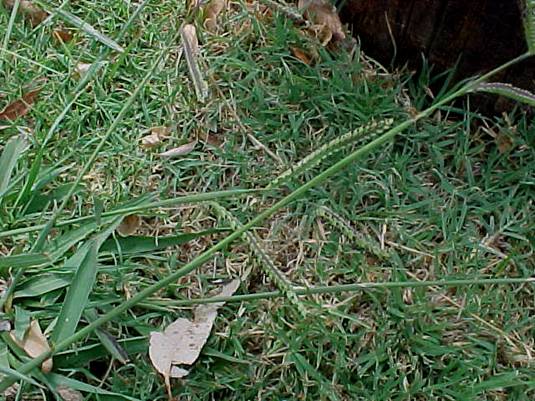
The flowering stalk grows 14 to 65 inches tall and
frequently has a purplish coloration at the base. The flower head
consists of 2 to 10 racemes (branches near the top of the flowering stalk) that
arise from different points along the flower stalk and are often drooping. Each
raceme has 2 rows of flat, egg-shaped spikelets,
which contain the seed along its entire length. These appear as small black
dots along the raceme.
Factors Important in
Control.
A major component of Dallisgrass management is
to prevent new plants from becoming established. In small scale turf it is best
to physically remove small plants before rhizomes and seed production develops.
Care should be taken to remove all of the plant since leaving any of the
rhizomes will frequently result in regrowth. When Dallisgrass is present in abundance or the plants are located
over a large area, it may be necessary to supplement cultural practices with
herbicides.