|
|
|
|
Common Teasel-Teasel Family
Dipsacusfullonum Characteristics. Teasels are monocarpic perennials. The plant grows as a basal rosette
for a minimum of one year, then sends up a tall, flowering stalk and dies
after flowering. The rosette stage varies according to the amount of time
needed to acquire enough resources for flowering to occur. Teasel grows in
open, sunny habitats that range from wet to dry levels. Optimal conditions
seem to be mesic habitats. Roadsides and heavily
disturbed areas are the most common habitats of teasel. Teasel sometimes
occurs in high quality prairies, savannas, seeps, and sedge meadows. The
teasel population has rapidly expanded in the last 30 years. Movement has
been documented along highway systems, where dispersal is aided by mowing
equipment. Teasel is an aggressive exotic that forms extensive monocultures. Teasel produces an abundance of seeds. A
single teasel plant can produce over 2,000 seeds; up to 30-80% of the seeds
may germinate. Seeds may remain viable for at least 2 years. Seeds typically
don't disperse far; most seedlings will be located near the parent plant.
However, highway mowing equipment and inappropriate disposal of dried teasel
heads from flower arrangements can increase the spread. Dead adult plants
leave a relatively large area of bare ground formerly occupied by their own
basal leaves, providing an optimal nursery site that new plants readily
occupy. Seeds may be water-dispersed, which allows dispersal over longer
distances. Immature seedheads of cut-leaved teasel
are capable of producing viable seed Identifying Characteristics.
During the rosette stage, leaves change from being somewhat ovoid in the
younger stage to large, oblong, and quite hairy in the older stage. During
the rosette phase, teasel develops a large taproot. The taproot may be over 2
feet in length and 1 inch in diameter at the crown. Cut-leaved teasel blooms
from July through September; common teasel blooms from June through October.
Flowering plants have large, oblong, opposite, sessile leaves that form cups
(the cups may hold water) and are prickly, especially on the lower midrib.
The leaves of cut-leaved teasel are broader and have feathering lobes. Stems
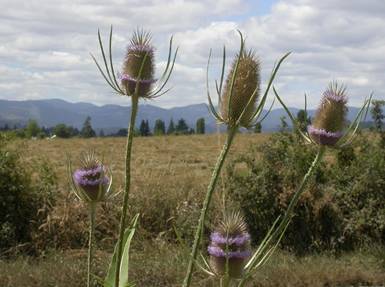
are also prickly. Teasel's unique inflorescence makes the plant readily
identifiable when flowers or seed heads are present. Flowers are small and
packed in dense, oval-shaped heads. The flowers are subtended by stiff, spiny
bracts that are located terminally on the flowering stems. Cut-leaved teasel
usually has white flowers, while common teasel generally has purple flowers.
Flowering stems may reach 6-7 feet in height. The two species may hybridize. |
|
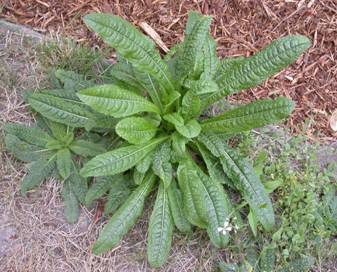
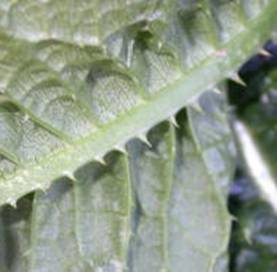
Foliage is oppositely arranged, sessile,
and linear. During the second year, tall prickly stems up to 6 feet in height
develop terminal with flower heads.
.
Uses. The
common and cut-leaved teasels are European plants introduced to
Mechanical Control: Cutting,
digging, and burning are recommended as the best solutions for control in
natural areas. In small areas, rosettes can be dug up using a dandelion digger.
Like dandelions, as much of the root as possible must be removed to prevent resprouting. Cutting with a sharp spade or shovel below the
surface of the soil can be helpful, but the area should be checked later for resprouts. As an alternative, the stalks of flowering
plants can be cut just before flowering. The plant should not reflower, but instead die at the end of the growing season.
Cut flowering stalks should be removed from the natural area if the flowers
have opened, because seeds can mature on the stem even after cutting. Cutting
the flowering stalk before the full bud stage should be avoided because the
plant will usually send up new flowering stalks. Cutting flowering stems may
need to be repeated for several years to control teasel. Teasel in nearby areas
should also be eliminated to prevent introduction of new seed.
Late spring burns can be useful in
controlling teasel before it becomes dense. Burning should be employed with
other methods to insure maximum control. Manual removal is assisted by burning
the site in the spring so that the basal rosettes are visible amidst the
blackened soil and grasses.
Chemical
Control: Triclopyr is dicot-specific
and can be applied to foliage and stems at 2% active ingredient (a.i.) during the growing season, preferably before the
plant has bolted (sent up a flowering stalk)--triclopyr
is apparently the more effective of the two. Glyphosate
is also effective when applied to foliage and stems at 12-2% a.i. before bolting, although it is non-selective. Herbicide
can be applied after bolting, but seed development remains a risk. The rosettes
of teasel remain green late into the fall, after most other plants have become
dormant--application at this time reduces the risk of harming non-target
species. Glyphosate may also be effective during the
dormant season, providing the rosettes are
photosynthesizing when glyphosate is applied.