|
|
|
|
Chicory-Aster
Family Coffee-weed,
blue daisy, succory, blue sailor, blue dandelion,
wild chicory, blue-weed Chicorium intybus
Identifying Characteristics. One of these showy weeds or
wildflowers - depending on your personal biases - now in bloom is chicory (Cichorium intybus).
Where did it come from and how did it get so widely spread? Chicory is a
member of the daisy family and a close relative of dandelion. It's a
perennial herb with a long, dandelion-like taproot and a whorl of oblong,
broadly toothed, milky-sapped leaves. When it flowers, it produces 3- to
5-foot tall, erect, zig-zagging flowering stems
with vestiges of a few leaves and a profusion of sky-blue flowers. The
flowers are multi-petaled and produced during much
of the late spring and summer period. The 50 cent-sized blossoms open as the
day awakens but close as the heat of the day becomes intense. Plants remain
in bloom for several months and a field of chicory viewed in the right light
looks like a heavy fog settled in a valley. Like dandelion, the seeds are
spread freely by wind. Also, like dandelion, the foliage is concentrated in a
whorl of leaves just above the soil surface so plants tolerate highway
department mowing without flinching. This prostate growing perennial
begins with a basal rosette adding numerous stems through the growing
season. The rough leaves and deep
taproot produce white milky sap that is bitter tasting. Rosettes are
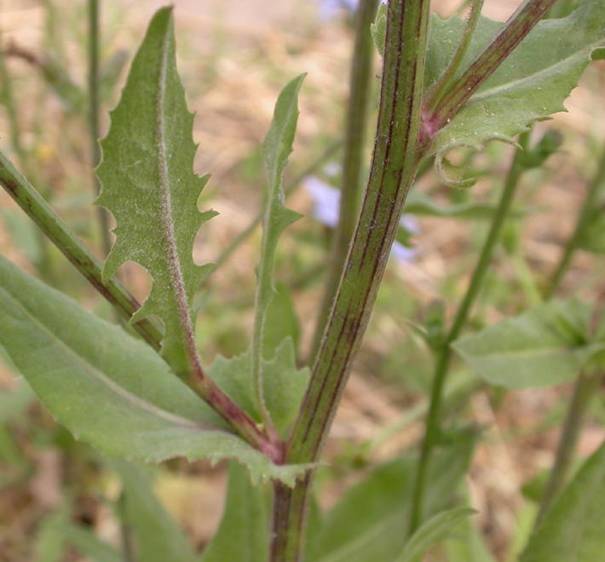
variable, but generally resemble those of dandelion. Leaves are pinnately lobed, 6 to 8 inches long, sparsely pubescent,
sessile and clasp the stem.
The
stems are ridged and often have red-purple longitudinal stripes.
The stark
blue color, shape and black glandular structures in the middle of the flower
are characteristic. In addition the 1 ½
inch diameter flower heads are born in the leaf axils. .
Like
dandelion, chicory has been grown since ancient times as a pot herb. Until
recently, chicory seems to have enjoyed limited use in the American cuisine,
except for areas with a large ethnic population from southern Europe. When
most of us think of chicory, we are thinking of coffee, not vegetable greens.
The use of roasted chicory roots as an adulterant for coffee seems to be a
French thing, possibly starting during the Napoleonic era when supplies of
coffee were disrupted during the Revolution. In the U.S., chicory-laced
coffee is found primarily in New Orleans. The
principle ingredients of chicory root are two polysaccharide, inulin and fructose. When roasted, inulin
is converted to oxymethylfurfurol, a compound with
a coffee-like aroma. Two
bitter principles found in the root, lactucin and lactucopicrin, were shown in a lab-rat experiment half a
decade ago to have sedative properties. Apparently, the claims that
chicory-laced coffee counteracts the stimulant properties of caffeine trace
back to this report. The current coffee craze that is sweeping the land had
its roots in Seattle, not New Orleans, so you'll have to travel south or buy
your brew over the Internet if you want that Cajun specialty. |
|