Barnyardgrass-Grass Family
Japanese millet, watergrass, Barnyard
millet
Echinochloa cruz-galli
Characters. This
European import is commonly found in cultivated fields and landscaped areas
throughout the western US and world. It will grow in almost any situation and reproduces by seed
and will root at lower leaf nodes... The
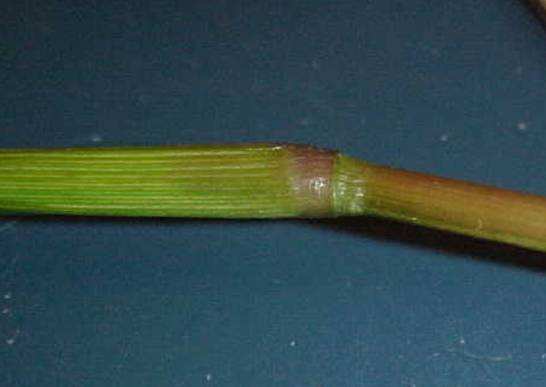
stem is flat and erect with roots at its nodes. The leaves are linear with a
broad round base narrowing at the tip. The flower head is reddish, purplish,
pinkish or greenish. The seed head is windmill-shaped and the seeds are short
with stiff awns. The plant can grow up to 2 m tall. It completes its
development in 42-64 days. Each plant can produce up to 40,000 seeds.
The young weeds resemble rice seedlings and they are often transplanted by
mistake.
The stem is flat and erect with roots at
its nodes. The leaves are linear with a broad round base narrowing at the tip.
The flower head is reddish, purplish, pinkish or greenish. The seed head is
windmill-shaped and the seeds are short with stiff awns. The plant can grow up
to 2 m tall. It completes its development in 42-64 days. Each plant can produce
up to 40,000 seeds. The young weeds resemble rice seedlings and they are often
transplanted by mistake.
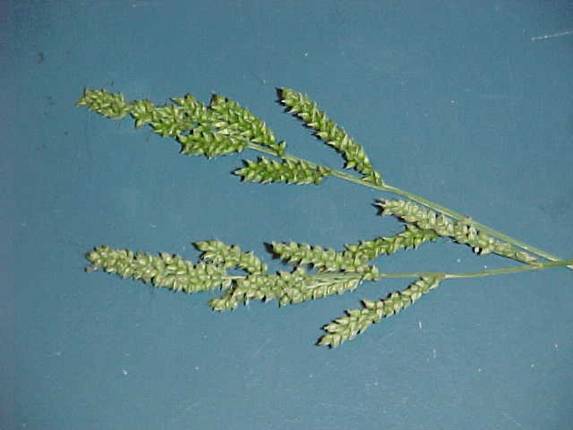
The spiklets often have a
reddish color and are crowded with or without awns.
Impact. Studies
show that a single barnyard grass per square foot can reduce rice yields by
about 25%, and 25 barnyard grasses per square meter can cause about 50% yield
loss. The mature plant grows higher than rice, so that it competes for
sunlight, besides soil nutrients. It is also an alternate host for tungro and
rice yellow dwarf viruses. Barnyard grass can reduce corn yields by 20%. It is
an alternate host for corn's pests. On the other hand Barnyard grass is used as
fodder for livestock, young leaves are used as vegetables, and the seeds are
used as human food.
Cultural
Control. Any or all of the follow will go a long way to prevent
the buildup of this weed in cropping situations. Proper selection of weed free
seed is the first step in control. 2.
Proper seedbed preparation to prevent the weeds from growing on the seedbed is
also of used. Remember that the weeds look like rice seedlings and are always
transplanted by mistake. 3. Thorough
land preparation by plowing and at least harrowing twice. 4. For
rice, it is better not to practice direct seeding. Transplanted seedlings are
more competitive than directly sowed ones. 5. Closer planting to prevent the germinating
weed's seeds from receiving sunlight. 6.Regular plant
monitoring. 7.Hand weeding during the early days of
growth. Removing the weeds before they flower. 7. Deep
flooding (submerging the whole plant. 9.Crop rotation