CHAPTER 8.
Mayflies,
Dragonflies and Stoneflies
Mayflies.
Adult mayflies are medium-sized,
soft-bodied insects with two to three elongate tail-like structures extending
from the tip of the abdomen. Their wings typically are triangular in shape and
have numerous veins (Figure 8A). The hindwings are small and round or absent
and are held together and straight over the body when the insect is at rest.
Adult mayflies lack mouthparts and do not feed; consequently they are
short-lived. Their order name (Ephemeroptera) significantly relates to their
mode of life. Ephemero in Latin means
one day and of course ptera means wings. Some species live just a few hours in
the adult stage.

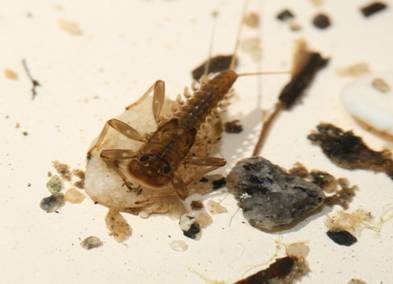
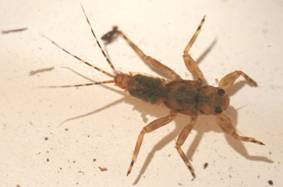
Figure 8A. Left. A
mayfly adult—characterized by lack of mouthparts, triangular front wings and
long anal cerci. Image Courtesy of Peter Chew. B. Mayfly nymph or
naiad.
The aquatic
nymphs, or naiads, may require a year or two to develop (Figure 8A). When ready
to change into adults, they crawl up on vegetation and molt. This first winged
form is not the mature adult (imago), but is called a subimago (unique to their
order). Upon emerging from the water, they fly a short distance and molt into
the adult stage within a day. Mayfly nymphs feed chiefly on algae with some
being predatory. In many areas they are the most common insects in streams and
lakes. Being so common, they are extremely important in food chains as the main
diet of many fish, birds, spiders, salamanders, and predatory insects.
In some cases
these insects reach such huge numbers in lakes that the emergence of the adults
can become a nuisance. Up until about 40 years ago, dead adults piled as high
as five feet were observed along the shoreline and under lights along roads
near the
Dragonflies, Damselflies.
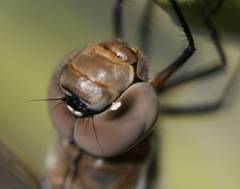
Dragonflies are relatively large insects
that are characterized by huge protruding eyes (Figure 8B), a stalk-like
abdomen, well-developed wings with many veins and
small hair-like antennae that are barely visible. Dragonflies and damselflies
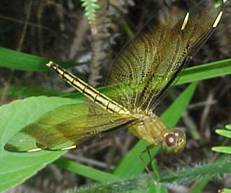
can be distinguished from each other by the way they hold their wings when at
rest. When not in flight, dragonflies hold their wings straight out from the
body (Figure 8C) while damselflies hold their wings folded over the abdomen
(Figure 8D). The dragonflies (200
million years ago) were very similar in appearance to the modern day forms except,
in some cases, they were much larger; there are fossil records of dragonflies
with a wing span approaching three feet.
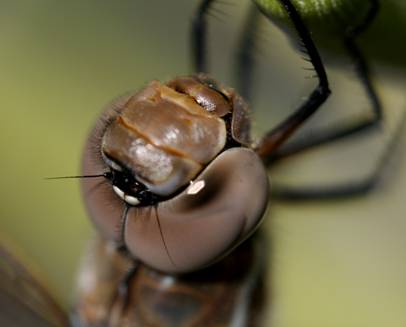
Figure 8B. Dragonfly head with huge compound eyes and hair-like antennae.

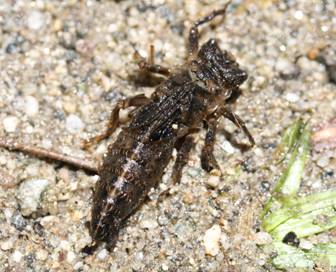
Figure 8C. Left. Adult dragonfly
with wings held at 90 degree angle from body when at rest. Right.-Dragonfly nymph.
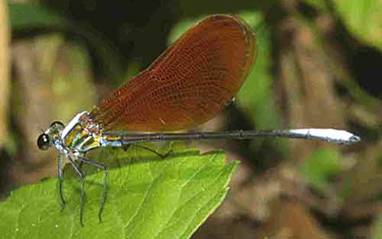
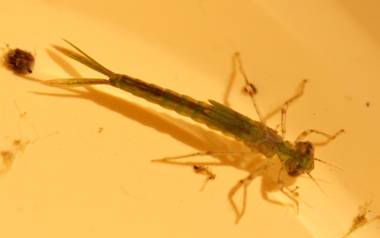
Figure 8D. Left. An
adult damselfly with wing held folded over abdomen when at rest. Right-Damselfly naiad.
Dragonfly and
damselfly nymphs (Figure 8C, 8D) are aquatic while the adults are terrestrial,
but are usually found near water. Nymphal Odonata breathe by means of gills. In
damselflies the gills appear as three000 feather-like structures (Figure 69) that
protrude from the tip of the abdomen. Gills of dragonflies are ridged and line
the rectum internally. They breathe by drawing water into the rectum and over
the gills. This water is subsequently forcibly expelled out the anus, thus
moving the nymph by jet propulsion.
Nymphal and
adult dragonflies are predatory. The nymphs, or naiads, feed on a variety of
small aquatic organisms. Typically they lie in wait for prey either on a plant
or while partially buried in the mud. Even though most naiads feed on smaller
insects, some of the larger species are capable of preying on small fish, frogs
and salamanders. Occasionally they even become major pests at trout farms.
One of the
common prey of dragonfly nymphs is tadpoles which are usually easy targets. There is a form of one species of tadpole
(the green tail) that has developed a rather ingenious mechanism for survival
of the species. In this case the tadpole’s tail is normally developed, which results
in a relatively slow swimmer that typically cannot elude a stalking naiad. However if one of these green tail tadpoles
is captured by a naiad, it releases an alarm pheromone into the water as it is
consumed. Of course, this doesn’t do
that tadpole much good, but apparently the chemical now permeating the water
triggers other tadpoles of the same species to quickly undergo a radical change
in their overall appearance. One of the
most startling changes is the formation of huge tails that greatly increases
their mobility, thus allowing most to escape from these otherwise successful
predators.
Adult
dragonflies typically feed on mosquitoes and other flying insects. In order to
do so they are quite agile and fly as fast as 40 mile per hour. Their large wings and light bodies allow them
great ability to maneuver in air. They
can hover, fly backwards, shoot vertically upward or downward and turn around
in the distance of a single body length.
Adult dragonflies when actively seeking prey fly with their legs held in
a basket-like fashion that allows them to trap flying insects in the air. Their
legs are so highly adapted to aerial capturing of prey that they are incapable
of walking. Damselflies are much weaker
fliers.
Dragonflies
and damselflies usually lay their eggs directly in the water or on aquatic
vegetation. These insects typically complete one generation per year, with the
egg being the overwintering stage. In some species adults are active for only a
few weeks each year, whereas others may be seen throughout the summer over a
period of several months.
The mating
behavior of these insects is to say at least unique, rough, competitive and
even dangerous. They are unique from the standpoint of location of their sex
organs and method of copulation. Like
many other insects the male testes are located at the tip of the abdomen. However, unlike all other insects the penis
(aedeagus) and a small sperm storage pouch are located behind the third pair of
legs in the front of the abdomen. Before
mating the male dragonfly (or damselfly) basically must self inseminate by
looping the tip of its abdomen downward and forward and transfers its sperm to
the storage pouch and into its aedagus.
Once a suitable female is located he approaches from above and grabs her
behind the head with a pair of claspers on the tip of his abdomen. Once attached and if the female is receptive
she will curl the tip of her abdomen around to bring her vagina into position
with his penis thus working the pair into a hart-like mating position (Figure
8E).
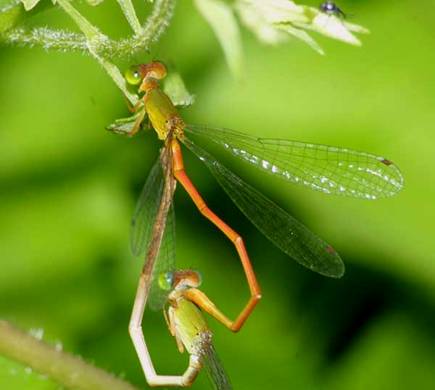
Figure 8E. A pair
of damselflies in mating position. Image
courtesy of John Moore.
Mating of dragonflies is quite competitive. It is not uncommon for a male to
select a 100-to-200 yard territory along a stream and to patrol that area
continuously during most of the daylight hours. Typically it will have two or
three locations (twigs, etc.) along the stream that are preferred for resting.
This territory is closely guarded and any other male of the same species that
enters the area is quickly chased out.
Of course females are readily accepted.
In addition with many species the male will actually remove or scoop out
any sperm in the storage area of the female (from previous mating with other
individuals) prior to injecting his.
Finally in many species, after inseminating the female, the male will
not release her with his claspers, but basically flies in tandem with her until
she releases her fertilized egg into the water (Figure 8F). In doing so he
guards and prevents other males from mating with her prior to oviposition.

Figure 8F. A male
damselfly holding female with his claspers while flying in tandem. Image courtesy John Moore.
As previously indicated mating can be rough, dangerous and
very aggressive. With some species the male will actually seize a female out of
the air and bite the base of her wings.
Others males will attempt to split mating pair by ramming, pulling and
biting them. In some species a
considerable amount of damage occurs to the female from the strong claspers of
the male. The dragon hunter is notorious for this. The spines of his clasping appendage gouge
the female’s eyes, puncture her exoskeleton and pierce her head.
Being such
large and obvious insects, it follows that they are important in cultural
beliefs around the world. In some societies, these amazing creatures are under
considerable suspicion. They sometimes are called “finger cutters,” “ear
stickers” and “eye pissers” and actually in some parts of the world they are believed
to be capable of sewing lips together and even crawling into an ear and
penetrating the brain. Japanese
dragonflies have an important part in literature and art, and are symbolic of
victory in battle. In many Asian
countries they are highly sought after as a delicacy. In Indonesia small boys
are sent to rice patties with long sticks smeared on the tip with a sticky
substance. When dragonflies land on the
tip (taking advantage of their behavior to rest on twigs) they cannot escape
and are collected and served fried with onions. In Thailand and other SE Asian
countries the nymphs are strained from streams and served roasted. They are said to taste like crayfish and are
high in protein, low in fat and cholesterol and provide a considerable amount
of roughage. Well at least they probably
taste like crayfish and are high in protein-I might have gotten a little
carried away there!
Stoneflies. The stoneflies are a small group of medium-to-large sized insects that
typically are found around streams and lakes. Adult stoneflies can be easily
recognized by their overall characteristic shape, well-developed anal cerci,
and weakly veined wings that lie flat over the abdomen when the insect is at
rest (Figure 8G). The adults are feeble fliers, relatively short-lived and
frequently seasonal in their appearance. Many species do not feed as adults
while others feed on lichen, algae and pollen.

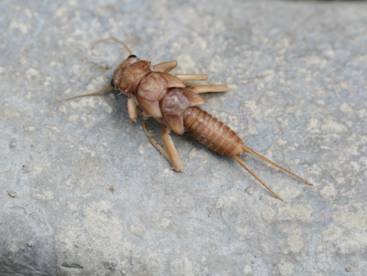
Figure 8G. An adult and nymphal stonefly.
Eggs usually are laid in large batches as the female hovers over water.
Development is quite slow with some of the larger species completing a single
generation in 1 to 3 years. Nymphal stoneflies (Figure 8G) typically are found
in lakes and streams where the bottom is covered by stones under which they can
hide. The nymphs or naiads are either predatory or phytophagous, consuming
algae, mosses and diatoms.
As might be expected, nymphal and adult stoneflies are an important
source of food for fish, birds, and other insect-eating predators. Fly
fishermen are quite familiar with stoneflies because many popular dry flies are
based on the adult forms of these insects.