CHAPTER 16
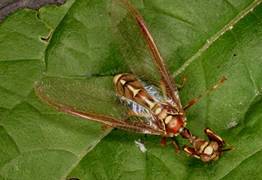
Antlions, Lacewings and Others
All the members of
this order are predatory in either the immature or adult stage or both. The adults lack anal cerci and many have
elongated sickle-shaped mandibles (Figure 16A).
Many of the larval stage also possess sickle-shaped mandibles.
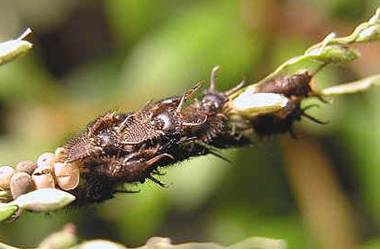
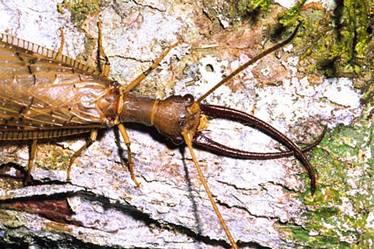
Figure 16A. Right. A Dobsonfly with greatly exaggerated
sickle-shaped mandibles. Image courtesy
of Bugbios, Dexter Sear. Left. Immature owlflies-Neuroptera. Image courtesy Peter Chew.
The
family Corydalidae contains
the megalopterous insects known
as dobsonflies and fishflies.
Making up about one dozen genera[1],
they occur primarily throughout the Northern Hemisphere, both temperate and
tropical, and South America.
They are sizeable Megaloptera, with a
body usually larger than 25 mm (1 inch). They often have long filamentous antennae,
though in male fishflies they are characteristically feathered. Ocelli are
present; the fourth tarsal segment is cylinder-shaped. The four large wings are
translucent, smoky grey, or mixed, and the anterior pair
is slightly longer than the posterior one.
The eastern dobsonfly, Corydalus cornutus, is the most well-known North
American species among the dobsonflies. These genera have
distinctive elongated mandibles in males and form thesubfamily Corydalinae.
The genera in which the males have normal mandibles, called fishflies, form the
subfamily Chauliodinae. The summer fishfly, Chauliodes pectinicornis, is perhaps
the best-known of these in North America; its immense mating swarms in
the Upper Mississippi River region fill
the air on a few summer nights each year much like mayflies in
certain regions of Europe, leaving millions of carcasses to be cleaned up the
next day.
The larvae are aquatic,
active, armed with strong sharp mandibles, and breathe by means of
abdominal branchial filaments.
When full sized — which can take several years — they leave the water and spend
a quiescent pupal stage
on the land, in chambers dug under stones or logs, before metamorphosis into the sexually
mature insect.

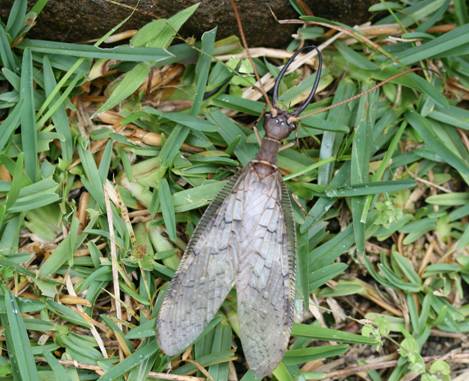
Figure 16B.
Typical dobsonfly adults. Left image courtesy Univ. Georgia Archives,
Bugwood.
Green Lacewings. These are a much
better known group of insects than the brown lacewings. They are typically much
larger (0.6 to 0.8 inch body length) and lack the hairy appearance of the body
and wings of their brown relatives (Figure 16C). As their name implies, most are green,
although shades of yellow are also common.
The adults are chiefly nocturnal while the larvae may be active during
the day.

Figure
16C. A green lacewing adult. Image courtesy of Joseph Berger, Bugwood.
The eggs are
deposited on a thin elongated stalk that serves for protection against
predatory insects such as ants or even their own hatching siblings. This engineering feat is accomplished by the
use of a quick drying material that is produced by a gland on the tip of the
abdomen. A drop of this material is
placed on a leaf and then the abdomen is quickly raised drawing it into the
thin stalk. Subsequently the egg is deposited
on the stalk (Figure 16D). The eggs of green lacewing are commercially
available as source of biological control of a number of pests.
Some species of
ants have developed the ability to climb the stalk, cut it and carry off the
egg. There are a few species of green
lacewings that places small droplets of oils along the length of the
stalk. This oil is repulsive to ants and
also makes the stalk more difficult for the ants to climb. Of course this also makes it more difficult
for the newly hatched lacewing larvae to climb down the stalk. This feat as easily accomplished as the larva
simply consumes the oil as it descends.
The adult green
lacewings have a variety of defensive mechanisms. When disturbed they emit a defensive stench
from a pair of glands located it the thorax.
One of the chemicals in this secretion is skatole, one of the main
components that give mammalian feces its smell.
Put more simply they smell like poop.
As with other insects
when flying green lacewings face potential danger from bats and spiders. As with some moths they can detect the
echo-locating pulses from a hunting bat and therefore are able to take
defensive maneuvers when pursued. They
are also frequently capable of avoiding detection of a spider once caught in
its web. They are relatively light
bodied and may not be initially detected by a spider once hitting its web. Subsequently
they do not flutter frantically in the spider’s web (as with many insects) but
proceed to slowly and precisely work their way out. Initially the lacewing uses its mouthparts to
cut any strands that have entangling its body, legs and or antennae. If its wings are entangles the lacewing
relies on gravity as it very slowly slides down the web to freedom. The veins of the wings of a green lacewing
are covered by very fine erect hairs which prevent the web strands from
reaching the flat membranous wing surface.
It may take up to an hour for this whole process to work but this is
certainly better than the alternative-death!
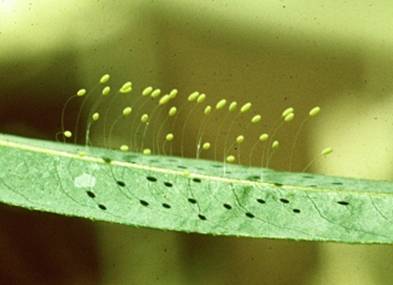
Figure 16D.
The eggs of a green lacewing on thin stalks. Image courtesy of Whitney Cranshaw, Colorado
State Univ., Bugwood.
The larval stage is
predatory feeding on aphids, mealybugs, other homopterous insects and
mites. They are often referred to as
aphid lions. They can readily be
recognized by the sickle-shaped mandibles and the presence of prominent body
tubercles ending in tufts of hairs (Figure 16E). Some species camouflage themselves by heaping
bits of litter and even the dead remains of their prey on their back. A common name for these species is the trash
carriers (Figure 16E). The entire life cycle generally takes 5 to 6 weeks with
the larvae passing through 3 instars.
These insects overwinter as pupae, generally in leaf litter on the
ground.
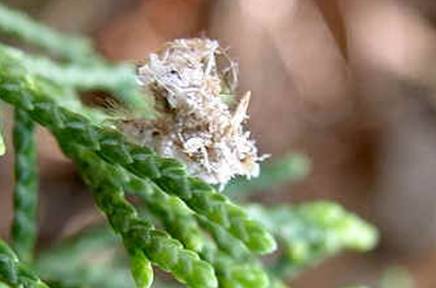
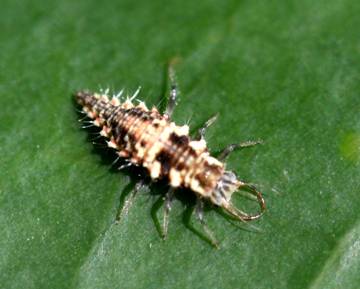
Figure 16E. The larval stagees of a green lacewin Left-Larvae
with remains of its prey on back. Image courtesy Peter Chew.
Antlions. This is the largest group of Neuropteran in North
America, occurring most commonly in the south and west. The adults are not as commonly recognized as
the larval stage. Adults resemble
damselflies with their stalk-like abdomens, but possess elongate club-shaped
antennae that are frequently hooked at the tip.
They are rather weak fliers and readily attracted to lights, especially
in summer months. Their eggs are
deposited in sand. The most well-known genus is Myrmeleo. There are
about 2,000 species.
Strictly speaking, the term "antlion" applies to the larval form of the members of this family,
but while several languages have their own terms for the adult, there is no
widely used word for them in English.
Very rarely, the adults are called"antlion
lacewings".
The antlion larva is often called "doodlebug"
in North America because of the odd winding, spiralling
trails it leaves in the sand while looking for a good location to build its
trap, as these trails look like someone hasdoodled in the sand.
Antlions are worldwide in distribution, most common in
arid and sandy habitats. A few species occur in cold-temperate
places. They can be fairly small to very large Neuroptera (wingspan range of
2–15 cm). The antlion larvae eat smallarthropods - mainly ants -, while the adults of some species
eat small pollen and nectar, while
others are predators of small arthropods in the adult stage too[2].
In certain species of Myrmeleontidae, such as Dendroleon pantheormis,
the larva, although resembling that of Myrmeleon structurally, makes no pitfall, but
seizes passing prey from any nook or crevice in which it shelters.
The adult has two pairs of long, narrow, multi-veined wings in which the apical veins enclose
regular oblong spaces, and a long, slender abdomen.
Although they greatly resembledragonflies or damselflies,
they belong to an entirely differentinfraclass among the winged
insects. Antlions are easily distinguished from damselflies by their
prominent, apically clubbed antennae which are about as long as head and thorax combined. Also, the pattern of wing
venation differs, with the very long hypostigmatic cell (behind the fusion
point of Sc and R1) being several times as long as wide. They also are very
feeble fliers and are normally found fluttering about in the night, in search
of a mate. The adult is thus rarely seen in the wild because it is typically
active only in the evening. They are highly active in desert regions and are a
nuisance. They will deliver a small, mildly painful bite if given the chance to
land on someone.
The life cycle of the antlion begins with oviposition
(egg-laying).
The female antlion repeatedly taps the sand surface with the tip of her abdomen.
She then inserts her abdomen into the sand and lays an egg. The antlion larva
is a ferocious-appearing creature with a robust, fusiform body, a very plump abdomen,
the thorax bearing three pairs of walking legs.
The prothorax forms a slender mobile
"neck" for the large, square, flattened head, which bears an enormous
pair of sicklelike jaws with several sharp, hollow projections. The jaws are
formed by the maxillae and
mandibles, which in each pincer enclose a canal for injecting venom
between them. Depending on species and where it lives, the larvae will either
hide under leaves or pieces of wood, in cracks of rocks, or dig pits in sandy
areas. Antlion larvae are unusual among the insects as they lack an anus. All
the metabolic waste that is generated during the larval stage is stored and is
eventually emitted as meconium near the end of its pupal stage.[3]
The pupal stage of the antlion is quiescent.
The larva makes a globular cocoon of sand stuck together with fine silk spun from a slender spinneret at the
posterior end of the body. These cocoons may be buried several centimeters deep
in the sand. It remains there for one month, until the completion of the
transformation into the sexually mature insect, which then emerges from the
case, leaving the pupal integument behind, and climbs to the surface. After
about 20 minutes the adult's wings are fully opened and it will fly off in
search of a mate. The adult is considerably larger than the larva; they exhibit
the greatest disparity in size between larva and adult of any type of holometabolous insects, by virtue of the adults
having an extremely thin, flimsyexoskeleton - in other words, they have extremely
low mass per unit of volume.
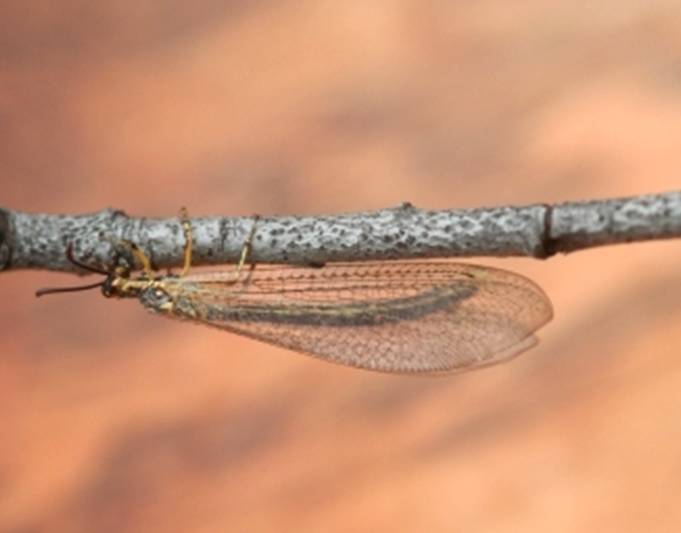
Figure 16F. The
adults of antlions-note the hooked-clubbed antennae, Image courtesy Whitney Cranshaw,
Colorado State Univ., Bugwood.
Antlion larvae
(doodlebugs) are strange looking insects with elongate sickle-shaped mandibles
and fringed lateral projections on the abdomen (Figure 16G). Some larvae remain motionless on the surface
of the soil or buried just beneath the surface, waiting for passing prey. When aroused, they give chase and quickly
subdue the victim with their piercing jaws.

Figure
16G. Antlion larvae or doodlebug.
In more notorious
species, the larvae capture their prey by means of a pitfall. They construct a small cone-shaped pit
(Figure 16H) in the soil and remain buried at the bottom. When a passing ant or
other potential prey falls in, the larva will begin to jerk its flattened head
upward, throwing sand in an attempt to undercut the sloping walls of the
pit. If the ant does not fall to the
bottom of the pit due to the quickly eroding walls, it may be knocked down by
the catapulting sand particles. Once
captured, the ant is quickly pulled below the soil and consumed.
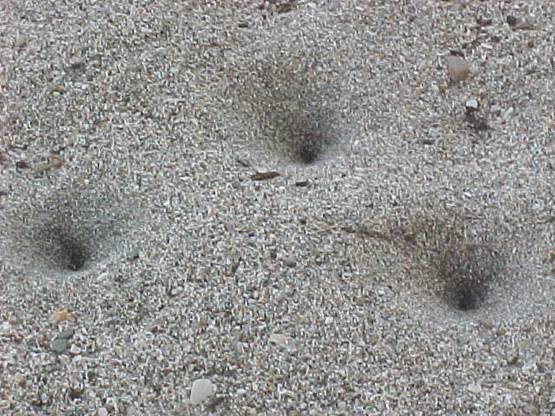
Figure 16H. Antlion larval pits.
Mantispids.
Although
possessing many of the characteristics of other Neuroptera mantispids look more
like mantids than lacewings. They are smaller
(more or less 1 inch in length) but possess the large raptorial front legs and
a similar body of a mantid (Figure 16I).
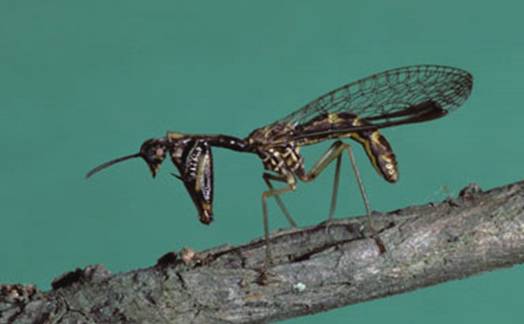
Figure 16I. Mantispids.
Image courtesy of Gerald Lenhard, Bugwood.
The adults of the bizarre insects are obviously
free-living predators (raptorial front legs) while the larvae of some species
exhibit a very unusually existence.
These feed on the eggs of spider.
Since spider eggs are not that easy to find and if found can be a
dangerous commodity (some spiders guard their egg sacs and are capable of
eating adult mantispids), these insects have developed a rather ingenious means
of reaching their prey. The adult
deposit their eggs on the end of short stalk that is attached to leaves (much
like those of the green lacewings). Once hatched some of the very active tiny
larvae seek out a spider and hop on.
They ride on the spider until she lays her eggs (if they found a
female). If not they presumably wait for
the male to find a mate and subsequently transfer the female during mating,
particularly in spiders where the female eats the male after mating. While riding on the spider the larvae may
feed by crawling into the spider’s book-lungs and snack on her blood. When the spider molts in preparation for egg
laying the larvae will leave the book-lungs and sit on top of the spider’s
petiole (thin stalk that attaches the cephalothorax to the abdomen) until the
eggs are deposited. Once deposited the
tiny larvae quickly crawls into the egg mass before the spider coats it with a
protective silk covering. The larvae
feed and complete their life cycle (except the adults) within the egg mass.