CHAPTER
1


The
Success of Insects
Many entomologists (unusual and sometimes weird people
who study bugs—most are weirder than you or me, of course) think that insects
and their relatives are the most successful living organisms on the earth,
while many others might quickly point out that humans rule the earth. Both
points of view have merit, but consider the following: one measure of success
is endurance. Fossil records indicate that insects and their relatives have
been on earth for more than 300 million years. This number becomes even more
meaningful when one considers that human existence dates back only 3 million
years. Such a long-term record has allowed insects and their relatives to
occupy almost every available ecological habitat and certainly has given them
time to develop a huge variety of behaviors that lead to their success.
It is estimated that there are between 4 and 14
million insect species worldwide—most of which are yet to be discovered.
Excluding the other arthropods (spiders, ticks, scorpions and the like), there
are only about 1 million species of plants and animals combined. There is only
one species of human (Homo sapiens). The current human population is
approximately 6 billion; however, at any one time it is estimated there are 4
quadrillion individual insects on earth. Therefore, insects outnumber us by
almost one million to one. It may be difficult to realize how big a number 4
quadrillion is. To help in this realization, consider the following: a housefly
is typically thought of as an average-sized insect—measuring about 1/4 inch in
length. If we took 4 quadrillion houseflies and lined them up end to end,
this line would be long enough to reach around the world 150,000 times.
In terms of sheer biomass (total weight), insects outweigh
us 10 to 1. That is, for every pound on human on the earth, there are 10 pounds
of insects. Whether or not one believes that insects are the dominant
animals on the planet, it would be difficult to argue that they are not a very
successful group. This leads to the next question: why are they so successful?
One reason for the success of these animals is their small size—most insects
are smaller than a housefly. Small animals need little energy (food) in order
to develop and survive. In addition, smaller organisms live in microclimates
(very small areas) which, in many cases, allow them to thrive in otherwise
intolerable conditions. For example, the humidity on the surface of a plant
leaf nears 100% and the temperature is considerably lower than that of the
surrounding area. Consequently, leaf-feeding insects survive in the hottest,
driest deserts of the world—areas where they would quickly perish if exposed to
the everyday temperatures and humidities of a macroclimate. Also, small
organisms can hide more easily from potential predators.
Most insects are winged; this gives them the advantage
of great mobility to seek new environments when necessary. In addition, the
majority of insects exhibit complete metamorphosis; that is, they have an egg,
larval (caterpillar, grub or maggot), pupal (cocoon) and adult stage. This type
of development has an advantage, in that the 2 active and feeding stages (adult
and larva) live in different environments and feed on different materials;
consequently, they do not compete with each other.
Insects generally have a tremendous reproductive
capacity. Again, take for example the common housefly. The female is capable of
laying several hundred eggs and this insect can complete one generation from
egg to adult in as little as 10 days. Given this type of reproductive capacity,
if a male and female fly mated in April and all their offspring survived and
reproduced, and this cycle were repeated every 10 days, by mid-August of the
same year there would be enough adult flies to cover the earth by 45 feet.
Obviously this does not occur, but this type of reproductive capacity gives
insects a tremendous advantage, in that an average of only 2 offspring need
survive and reproduce every generation for success and survival of the species.
Finally, one of the main reasons for the success of
insects is their tremendous diversity of capabilities. Discussed below are some
extreme examples of these capabilities. Fecundity is the egg laying capacity of
insects that varies considerably from species to species. An Australian ghost
moth holds the highest recorded fecundity among nonsocial insects. One female
is capable of laying 44,000 eggs. Although astounding, this is meager when
compared to social insects such as the queen African driver ant that can
produce 4 million eggs every 23 days or the African termite queen that can
produce 10,000 eggs a day for 30 years (Figure 1A). On the other end of the
spectrum is the louse fly (Figure 1A) that produces a meager average of 4.5
eggs per female. In this case, the young are well cared for, insuring maximum
survival. After the eggs hatch, the maggots remain inside the female where they
feed on a specialized milk gland until fully developed.

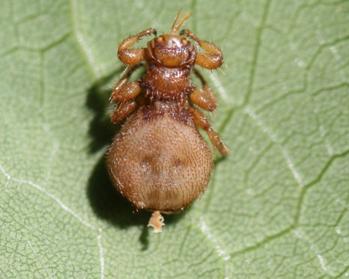
Figure 1A. Left. An African queen termite
can lay 10,000 eggs a day for 30 years.
Right. Louse fly-a wingless parasitic fly.
The life cycle of an insect is defined as that sequence
of events that begins with the egg and ends with the reproductive adult. Aphids
probably have the shortest life cycle among the insects, with some species
completing one generation, or life cycle, in as little as 5 to 6 days. On the
other end of the spectrum is the periodical cicada that requires 17 years to complete
one life cycle (Figure 1B). In some insects and their relatives, the normal
life cycle can be greatly extended in extreme environmental conditions. An
example is the long horned beetles that normally develop in rotting logs and
typically require 1 to 4 years to pass through one cycle (Figure 1C). However,
if a tree containing the grubs of these beetles is cut into lumber, the normal
environment changes drastically (less available nutrients and moisture) and
their life cycle can be extended 50 or more years. There is also a case of
extended dormancy, where water was added to some dried moss that had been in a
British museum for 106 years and tartigrades (insect relatives) emerged.


Figure 1B. A 17-year locust or
periodical cicada lives 17 years below ground as a nymph (right) and then dies
in a few days once it emerges as an adult.
Right image courtesy Peter Chew, Brisbane Insects.
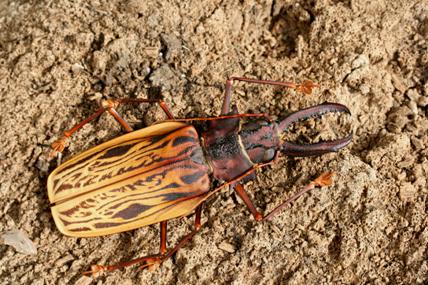
Figure 1C.
A. longhorned beetle-holds the longest known longevity while in the
larval stage.
Insects have a tremendous ability to withstand very
low temperatures. Surprisingly, the insect most able to survive the lowest temperatures
is not found in Polar Regions, but in tropical West Africa. There is a fly maggot
that inhabits shallow pools which are subject to drying out repeatedly. These
maggots can withstand severe desiccation or drying of their body moisture. In a
laboratory, these maggots can be desiccated or dried out and then dipped in
liquid helium for 5 minutes (-270 F) and when warmed up and rehydrated (body
water replenished), they will recover 100 percent of the time. This is not
totally surprising because the main factor leading to insect deaths after
exposure to extreme cold is the formation of ice crystals in individual cells
which causes the cells to rupture.
On the other hand, insects in general can not
withstand extremely high temperatures. The insects recorded as most tolerant to
high temperatures during every day life are several species of Sahara Desert
ants that forage over sand temperatures exceeding 140 (F) degrees. However,
some insects can withstand fairly high temperatures for a short duration. For example,
a fly maggot from Nigeria can be dipped in boiling water (212 (F) degrees) for
one minute and still survives.
Some insects are capable of flying very fast. It is
believed that some of the fastest flying insects are the hawk or sphinx moths,
with recorded speeds exceeding 40 miles per hour (Figure 1D). However, recent
research indicates that this record is far exceeded by a male horsefly chasing
a female at a speed exceeding 100 miles per hour. (She must have been really
cute!) It is not surprising that insects can fly so fast when one
considers the efficiency and speed of their wing beats. The record for this is
held by a species of midge that is capable of 1046 beats per second.
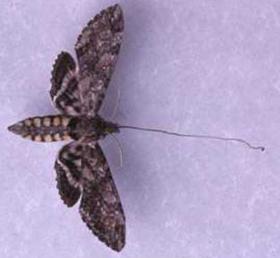
Figure 1D. A tobacco hornworm or
hawk moth is not only one of the fastest flying insects (40mph) but also has
the longest mouthparts or proboscis (uncoiled) of any insect. Image compliments of Bob Spencer.
Actually the caption in Figure
1D is not totally correct. Darwin in an
expedition into the jungles of Madagascar discovered a rare species of orchid
that had it nectaries (glands that produce nectar-a favorite food of insects)
located 12 inches deep in the throat of the flower. At that time he predicted that there must be
an insect that has the mouthparts that could reach this source of food. He was greatly criticized for this seemingly
ridiculous prediction. Approximately 180
years later a scientist found one of these rare flowers and decided to test
Darwin’s suggestion. After sitting in
the jungles of Madagascar for several hot, humid nights he filmed a hawk moth
(very similar to the above hornworm) appear and uncoil its mouthparts. In this case the beak or proboscis measure approximately
13 inches or over 4 time the body length of the moth.
Finally the speed at which
the snap jawed ant closes its mandibles (jaws) is the fastest of any anatomical
structure ever recorded in the animal kingdom.
The full strike, from the instant at which the fully opened mandibles
start to close until they clash together takes as little as a third of a
millisecond.-that is one-three-thousandths of a second. Previously the fastest recorded movement had
been the jump of a springtail-it seems significant that these ants feed on
springtails and would of course be faster.
Other recorded (fast movements) include the escape response of a
cockroach (42 milliseconds), the foreleg strike of a praying mantis (42
milliseconds) and the leap of a flea (1.2 milliseconds). This ant hunts with its disproportionately
long jaws wide open with a sensory hair-like trigger projecting forward between
the opposing mandibles.
These ants are also
referred to as the popcorn ants due to their unusual behavior of popping up
into the air when disturbed. Apparently this occurs when the tips of closing
jaws hit a hard surface causing the ant is flipped backwards into the air. This behavior is thought to be advantageous
in that these flying ants land on and readily attack (sting) potential
predators.
A Republic of
Insects and Grass. As we have discussed, insects
are an amazing group of animals. Some
can be dipped in boiling water for a minute or in liquid helium (-270) and
still survive. Some live in the harshest
environments on earth where humans can not survive, but what about their
tolerance to irradiation? There have
been many studies where a variety of plants and animals have been exposed to
irradiation to ascertain its sterilizing and lethal dose of each. One of the reasons for these studies was to
ascertain the potential effects of a nuclear war on the earth’s inhabitants. The
lethal dose for most mammals and birds lies between a few hundred to a thousand
rads of gamma irradiation. On the other
hand the lethal dose for some insects approaches a hundred thousand rads. In essence, if a large scale nuclear attack
were to occur, it appears evident the major survivors would be certain species
of insects (ants and cockroaches to name a few) and plants (grass is also quite
tolerant to irradiation).
CLASSIFICATION
and TAXONOMY
Any study of plants and animals necessitates some
scheme of classification into groups, or taxa. Organisms can be grouped by any
number of common characteristics, but the one followed by scientists is based
on similarities in structure—with those organisms having certain
characteristics in common being placed in one group and those having
others placed in another.
The animal kingdom is divided into a dozen or so major
groups called phyla (phylum, singular). Each phylum is further subdivided into
classes and so on. The main categories (taxa) of classification from the
largest to the smallest are phylum, class, order, family, genus, and species,
with frequent intermediate categories such as superfamily and subfamily. Humans,
for convenience and the need to organize for study, create most taxa. Probably
the only natural grouping is species. In nature a species if generally defined
as a group of organisms capable of interbreeding and producing fertile offspring.
Because the determination of taxa is more or less
arbitrary, different researchers often arrive at different schemes of
classification and also use different names for the same group. For example,
depending on the source (e.g. different textbooks), the order of scorpions has
been named Scorpiones and Scorpionida. We have attempted to use the simplest
names possible in this book.
The scientific name of a species is binomial; that is,
it has two names, the genus and species. In a manuscript these names are either
written in Italics or underlined. The genus name is always capitalized, but the
species name is not (e.g. Musca domestica). If a species is referred to,
but not named, it is written "sp." For example, Musca sp.
refers to an unknown species of the genus Musca. Most taxa names are
derived from Greek or Latin and, in many cases, translation is significant in
describing characteristics of a particular group. For example, in the order of
the flies (Diptera), 'di' in Greek means two, while 'ptera' means wings. One of
the main characteristics of this order is having two wings.
The phylum with which we will be dealing in this
course is Arthropoda (The Arthropods). Worldwide, this phylum is the largest
and contains far more species than all other plants and animals combined. This
phylum also possesses some characteristics of both higher and lower forms of
animal life. Some of these characteristics include a chitinous or hard
exoskeleton, a segmented symmetrical body, and segmented appendages. The main
classes dealt with in this text are the Chilopoda (centipedes), Diplopoda
(millipedes), Arachnida (arachnids) and Insecta or Hexapoda (insects). The
crustaceans are briefly mentioned here, but these forms are mainly marine. Some
common terrestrial crustaceans are the pillbugs and sowbugs.